Stage 01
Online · May 22 – June 1
Build a prototype
Ten days. A working sandbox that talks the API. Auto-evaluated on technical quality, documentation, and how you handle the basics of an SDLC — branches, tests, commit history.
10 teams advance.
A hackathon at Paradox, IIT Madras · 2026
Build a sandbox that runs untrusted code — in Go, on Linux.
May 22 → Paradox finale · solo or pairs · open registration
Who this is for
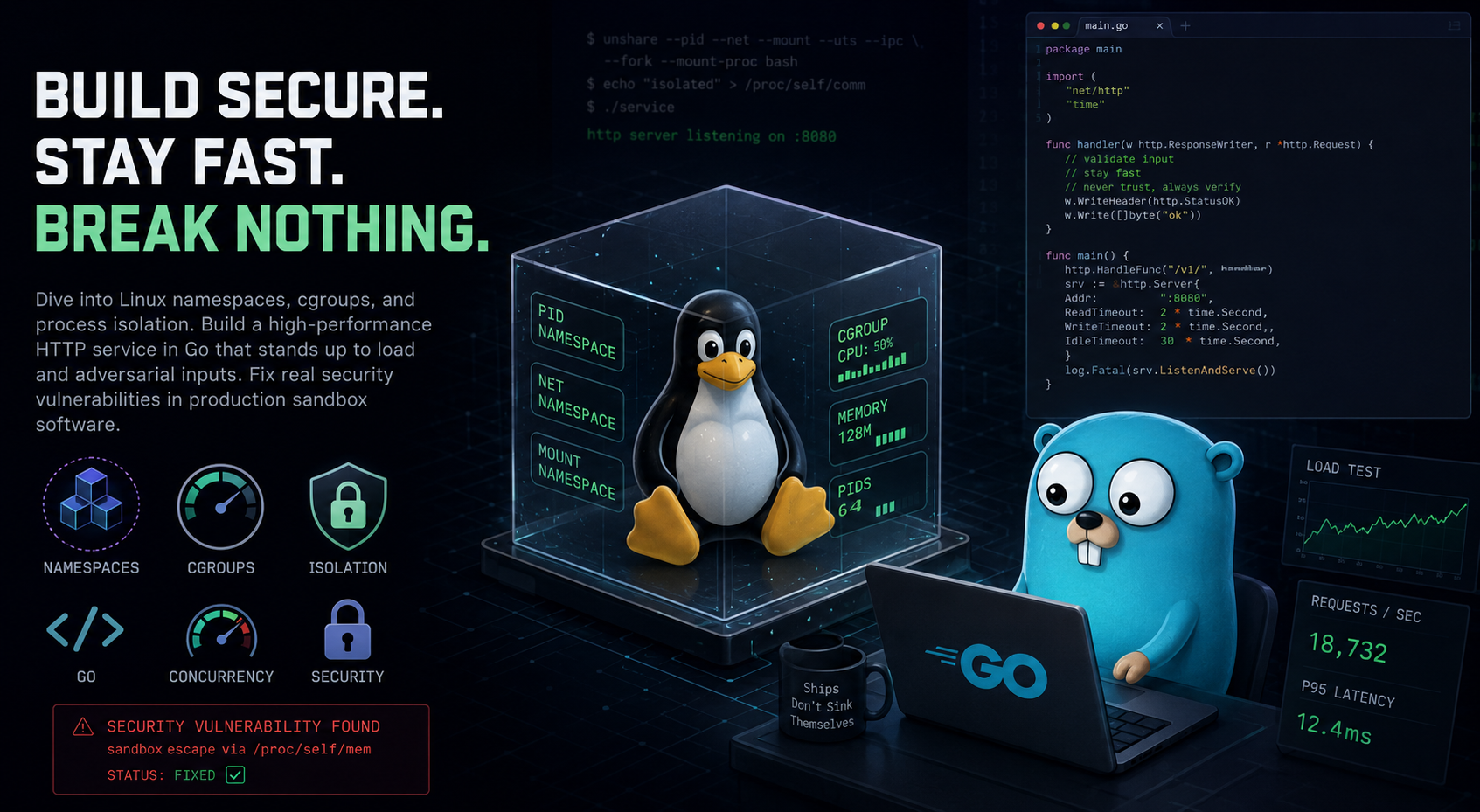
You'll spend time inside Linux namespaces, cgroups, and process isolation. You'll design an HTTP service in Go that has to stay fast under load and refuse to break when fed adversarial inputs. You'll close real security holes that exist in production sandbox software today — not toy ones.
This is a good fit if you're drawn to systems programming, Linux internals, Go, concurrency, sandboxing, security, or container-style isolation — or if you just want to find out whether that kind of work is for you. No prior nsjail experience expected. We give you a working Python reference to read so you start with a behaviour to match, not a blank page.
What you'll build
A small HTTP service that accepts a snippet of code, compiles and runs it inside an nsjail sandbox, and returns per-test results. Other people's code execution platforms do this. Yours will too.
To get you started, we hand you a working reference implementation in Python and Flask. It runs, it has tests, and it has a handful of deliberate security holes that we'll point you at directly. Read it as a behaviour spec. Then design the Go version the way you think it should be designed.

The three stages
Stage 01
Online · May 22 – June 1
Ten days. A working sandbox that talks the API. Auto-evaluated on technical quality, documentation, and how you handle the basics of an SDLC — branches, tests, commit history.
10 teams advance.
Stage 02
Online · June 4 – 5
24–36 hours. The 10 teams get an extension brief: your sandbox now needs to handle multiple language toolchains, plug-and-play.
Same 10 teams continue.
Stage 03
In person · Paradox · 24 hours
The final brief drops the morning of: security pressure and concurrent load. You work alongside SEEK engineers and demo what you built. This is when we get to know you.
Winners announced on site.
Rewards
Paid to all three podium teams.
Two slots · 4 months · ₹18,000 – ₹25,000 per month
Two paid internships at SEEK's tech team — one for each of the top two teams.
Who takes the slot and the exact stipend are decided after a short technical discussion.
Eligibility & logistics
FAQ