00
What a sandbox actually does
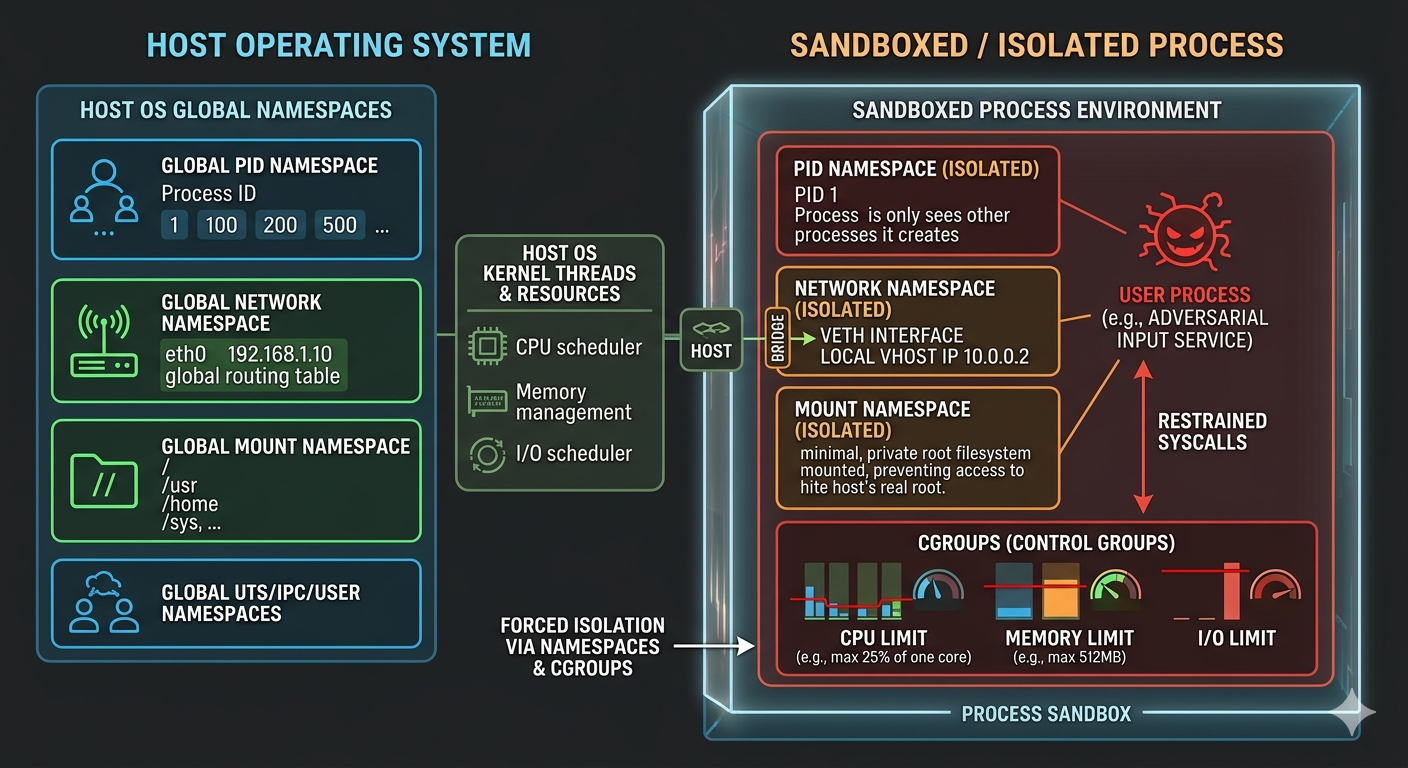
A sandbox is a process that the operating system has been tricked into treating as if it were on its own machine. On Linux, the trick is built from two primitives: namespaces (which give the process a private view of PIDs, network interfaces, mounts, users, and hostnames) and cgroups (which cap how much CPU, memory, and I/O it can use). Add a restricted set of syscalls on top, and a runaway program inside the sandbox can't see, reach, or starve anything outside it.
That's what goboxd is built around. Every POST /run request creates a fresh sandbox, runs untrusted code inside it, captures the result, and tears the sandbox down. Stage 1 of the hackathon is about getting that loop working at all. Stage 2 makes it polyglot. Stage 3 makes it survive adversarial pressure under load.
01
What to ship, by stage
Three stages, three escalating bars. Each is judged on what you have at the end of that stage, not on intent.
Stage 1 · prototype
- A Go HTTP service that builds and runs in Docker
/healthzreturns200POST /runruns two languages end-to-end: one interpreted (Python, Bash, or Node) and one compiled (C, C++, or Java)- Unit tests, a readable README, and a clean commit history
Stage 2 · polyglot
- All seven in-scope languages registered via YAML
/readyzand/inforeflect the registered set- A new language added in under 30 minutes with no Go code change
- Per-request limits and flag allow-lists enforced
Stage 3 · harden & load
- 5 of 7 security holes closed, with the fixes documented in the PR
- Bounded concurrency with a queue, not failures
- Benchmarks at 1, 10, 50, and 100 clients in
docs/benchmarks.md(p50, p95, p99) - Holds up under sustained load on judging day
02
The brief
Build a small HTTP service in Go that runs untrusted code inside an nsjail sandbox and returns per-test results. The service name is goboxd, short for "Go sandbox daemon."
A reference Python + Flask implementation is provided so you can read, run, and reverse-engineer the behaviour locally. It is intentionally a bit crusty. Read it as a behaviour spec, not as a guide.
The goboxd you build uses plain JSON on the wire, supports modern toolchains only, and is judged primarily on three things:
01
Plug-and-play languages
A clean language registry. We hand you a new language on demo day and you add it in 30 minutes with no Go code change.
02
Concurrency
Bounded, queued, benchmarked. Holds up under sustained load, not just micro-bursts.
03
Security
Close at least 5 of the 7 holes we point you at. Document where you fixed each in the PR.
In scope
C, C++, Java, Python 3, Bash, JavaScript (Node), Verilog. Per-test status. Per-request resource overrides. Per-request build/run flags (validated).
Out of scope
Anything binary on the wire, the reference's evaluation-script mode, the zip language, Python 2, authentication, rate limiting, queues, persistence, web UIs.
You may pick any Go HTTP framework: net/http, chi, echo, gin, whatever. Two-sentence justification in the README.
03
API contract
POST /run
Request body:
{
  "language": "cpp",
  "source": "#include <iostream>\nint main(){std::cout<<\"hi\";}",
  "source_filename": "solution.cpp",
  "artifact_filename": "solution",
  "build": {
    "limits": { "wall_time_s": 5, "memory_kb": 1048576, "max_processes": 100 },
    "flags": ["-O2"]
  },
  "run": {
    "limits": { "wall_time_s": 3, "memory_kb": 524288, "max_processes": 64 },
    "flags": []
  },
  "tests": [
    { "stdin": "1\n", "expected_stdout": "hi" }
  ]
}
Field rules
language: required. Must match a configured language id, otherwise 400.source: required, UTF-8. Subject to a server-imposed max size (default 256 KiB).source_filename,artifact_filename: optional. Required only for languages that need them (e.g. Java). Must be a single path component, with no separators, no leading dot, and a length cap.buildandrun: optional. Each can supplylimits(a partial override of the language defaults) andflags(extra args to the build or run command). Missing fields fall back to language defaults.flags: an array of strings. The server filters these against a per-language allow-list and rejects unsafe flags with a 400. See Security.tests: required, at least one entry. Eachstdinis fed to the program, andexpected_stdoutis compared to its stdout.
Response (200 once the run completes, regardless of user-code outcome):
{
  "status": "wrong_output",
  "build": {
    "status": "ok",
    "stdout": "",
    "stderr": "",
    "duration_ms": 412
  },
  "tests": [
    {
      "status": "wrong_output",
      "stdout": "HI",
      "stderr": "",
      "duration_ms": 38,
      "memory_peak_kb": 8192
    }
  ]
}
Errors
Errors that prevent any execution (bad JSON, unknown language, oversize body, malformed filename, disallowed flag) return HTTP 400:
{
  "error": {
    "code": "invalid_filename",
    "message": "source_filename must be a single path component"
  }
}
5xx is reserved for server failures (sandbox setup error, nsjail not found, disk full). Never return 5xx because the user code crashed.
GET /healthz
Liveness. Cheap, no dependencies. Returns 200 {"status":"ok"} if the process is up.
GET /readyz
Readiness. Returns 200 only if the nsjail binary is executable and every configured language's compiler/runtime resolves and passes its smoke probe (--version or a per-language override). On failure, returns 503 with a per-language breakdown:
{
  "status": "degraded",
  "nsjail": { "ok": true, "version": "3.4" },
  "languages": {
    "py3":  { "ok": true,  "version": "Python 3.11.2" },
    "java": { "ok": false, "error": "javac not found at /usr/bin/javac" }
  }
}
GET /info
Always 200.
{
  "build_info": { "version": "0.1.0", "commit": "abc1234", "go_version": "go1.22.3" },
  "nsjail": { "path": "/usr/bin/nsjail", "version": "3.4" },
  "languages": [
    {
      "id": "py3",
      "name": "Python 3",
      "version": "Python 3.11.2",
      "default_run_limits": { "wall_time_s": 9, "memory_kb": 102400, "max_processes": 100 }
    }
  ],
  "limits": {
    "max_source_bytes": 262144,
    "max_tests": 50,
    "max_concurrent_jobs": 16
  },
  "stats": {
    "in_flight_jobs": 3,
    "jobs_total": 41892,
    "jobs_failed_internal": 4,
    "last_internal_error_at": "2026-05-04T11:22:09Z",
    "disk_free_bytes_jail_dir": 53687091200
  }
}
Cgroup memory pressure or Go GC stats are welcome but not required.
04
Status vocabulary
| Scope | Allowed values |
|---|---|
build.status |
ok · failed · internal_error |
test.status |
accepted · wrong_output · output_whitespace_mismatch · time_exceeded · memory_exceeded · runtime_error · not_executed · internal_error |
| Top-level | accepted · build_failed · wrong_output · output_whitespace_mismatch · time_exceeded · memory_exceeded · runtime_error · internal_error |
Top-level rule: top-level status is accepted only if build.status == ok and every test is accepted. Otherwise it is the first non-accepted status in test order. If the build fails, top-level is build_failed and every tests[].status is not_executed.
05
Plug-and-play languages
Adding a language should be one YAML block and one PR. No Go code change unless the language needs custom logic.
Recommended shape. You may refine it; just document whatever you change.
languages:
  - id: py3
    name: Python 3
    source_filename: solution.py
    run:
      cmd: /usr/bin/python3
      args: ["{{source}}"]
      limits: { wall_time_s: 9, memory_kb: 102400, max_processes: 100 }

  - id: cpp
    name: C++
    source_filename: solution.cpp
    artifact: solution
    build:
      cmd: /usr/bin/g++
      args: ["{{flags}}", "-o", "{{artifact}}", "{{source}}"]
      limits: { wall_time_s: 3, memory_kb: 1048576, max_processes: 100 }
      flag_allowlist: ["-O0","-O1","-O2","-O3","-Wall","-Wextra","-std=*"]
    run:
      cmd: ./{{artifact}}
      limits: { wall_time_s: 3, memory_kb: 524288, max_processes: 64 }

  - id: java
    name: Java
    source_filename_strategy: from_request
    artifact_filename_strategy: from_request
    build:
      cmd: /usr/bin/javac
      args: ["{{flags}}", "{{source}}"]
      limits: { wall_time_s: 6, memory_kb: 102400, max_processes: 100 }
    run:
      cmd: /usr/bin/java
      args: ["{{artifact}}"]
      limits: { wall_time_s: 6, memory_kb: 102400, max_processes: 100 }
What we look at on demo day
We'll hand you a language we don't already support (Rust, Go, Kotlin, Ruby, etc.) and ask you to register it. You should be able to do it in 30 minutes or less, with no code change. Just a YAML edit, an installation script during the Docker build, and a smoke test. We'll watch you do it.
We also look at: clear placeholder semantics, startup-time validation that fails loudly with a useful error, and /readyz and /info reflecting the registered set automatically.
06
Security
The reference has the holes below. Fix at least five in your Go version. Each extra one above five counts as a bonus. In your PR description, list which ones you closed and link to the file:line where you closed each.
-
Path traversal via filename.
The reference joins the jail directory with a client-supplied filename and writes the file with no validation. Values like
../../etc/passwdor absolute paths escape the jail dir on the host. Validate strictly. - Shell-style directory commands. The reference creates and deletes per-request directories by string-formatting commands and running them through a shell. Use the language's filesystem APIs; audit every path-handling line.
-
Compiler-flag injection.
The reference appends arbitrary client-supplied args to
gcc,g++,javac. Flags like-fplugin=...,-x c,-B...,--specs=...,-Wl,...,@response_filegive compile-time code execution. Per-language allow-list, reject the rest with400. -
No request size limits.
Source size, test count, per-test stdin and expected size, captured stdout and stderr: all unbounded. Cap them at the HTTP layer and at the sandbox layer (
rlimit_fsize, capped reads). - UID collisions under load. The reference picks a UID from a 30k-wide range and retries three times on collision. Use a process-unique scheme (atomic counter + PID + random suffix, or a tempdir API) and never reuse a directory.
- Unbounded child output. Reading the full child stdout into memory lets a runaway program OOM the host. Cap captured output and truncate with a marker.
-
Stale jail directories.
A panic between create and cleanup leaks the directory. Cleanup must run on every exit path (Go:
deferat the right scope) plus a startup sweep of orphans older than N minutes.
07
Concurrency
The judging weight on concurrency is high. We want evidence, not vibes.
- A bounded global concurrency limit, configurable (env var or YAML), default
runtime.NumCPU(). When the limit is reached, requests queue rather than fail. - A small load-test script in the repo (
hey,vegeta,k6, or your own). - A
docs/benchmarks.mdshowing requests/sec and p50/p95/p99 for the trivial "Hello World, py3" case at 1, 10, 50, and 100 concurrent clients on whatever box you measured on. Numbers from a clean Docker run, not from a debugger. - Per-request CPU and wall-clock time captured and visible somewhere. Logs are fine.
Don't optimise micro-benchmarks while starving under sustained load. We will do a sustained-load run during judging.
08
Repo structure and tooling
The repo at submission time should be self-contained and run from a fresh clone in under 10 minutes.
- Dockerfile. Builds the binary, builds nsjail from source at image-build time, and installs every supported language toolchain. The container is the unit of "it works." nsjail must be added as a git submodule (preferred) or fetched in the Dockerfile, pinned to upstream tag
3.4, and built inside the image. Do not bundle a prebuilt binary. Do not assume the host has nsjail installed. Do not install it from a package archive. Expect to seegit submodule add https://github.com/google/nsjail external/nsjail(or equivalent) and a build step in the Dockerfile. - Docker Compose. Brings up the server for local development with a single command.
- Makefile. Every common operation has a target. At minimum:
make build,make run,make test,make integration,make load,make lint. No barego runinstructions in the README. - The docs/ folder. Anything longer than a paragraph lives here as its own file:
docs/api.md,docs/languages.md,docs/security.md,docs/benchmarks.md,docs/architecture.md. - README.md. Short. What it is, how to run, where the docs are. Write it as a human wrote it. No AI filler. No "elegant", "robust", "seamlessly", or "leverage". No emoji decoration. No marketing copy. If a sentence wouldn't survive a code review, cut it.
- Tests. Unit tests on everything that doesn't need nsjail: config loading, filename validation, flag allow-listing, status mapping, output truncation. At least one end-to-end test per in-scope language.
- Format and linting.
go vetandstaticcheck(orgolangci-lint) must be clean.
Everything runs in Docker. If we can't docker build and docker run your repo and have /healthz return 200, you're not finished.
09
Judging
On judging day, we run a private corpus of POST /run requests against your container, plus the demo-day language addition, plus a sustained-load run.
| Criterion | Weight |
|---|---|
| Plug-and-play language model (YAML, ease of adding, demo-day add) | 25% |
| Concurrency: architecture, benchmarks, sustained-load behavior | 20% |
| API contract conformance (every field, every status, every error case) | 15% |
| Security holes closed (5 required, more = bonus) | 15% |
| Code quality, readability, tests | 10% |
| Languages beyond the in-scope seven | 10% |
Health endpoints (/healthz, /readyz, /info): accuracy and completeness | 5% |
Bonuses
- Languages beyond the seven in scope. Rust, Go, Kotlin, C#, Ruby, Lua, OCaml, Swift, Zig. Each one that passes its smoke probe on
/readyzis worth one point. - Closing more than five of the seven security holes. Each extra closure counts for half the score of a required one.
- Structured request logs. One JSON line per request, with request id, language, durations, and status.
- A clean architecture doc at
docs/architecture.md. Good enough that we could hand it to a new engineer on their first day.
10
Submission
Submission repo: github.com/thesouldev/goboxd. Base branch: master. The workflow is plain open-source: fork, branch, PR. We do not add you as a collaborator.
- Register through the Paradox listing. That is how we know you exist.
- Fork the submission repo. Fork
thesouldev/goboxdto your own GitHub account, or to a team account if you are working as a pair. - Create a team branch. In your fork, branch off
masterasteam/<your-team-name>. - Work on that branch. Commit and push to your fork as often as you like. Keep the history clean. Avoid one giant commit for the whole feature; we want to see how you worked.
- Open a PR before the deadline. Open it from
<your-fork>:team/<your-team-name>back tothesouldev/goboxd:master. Mark it ready-for-review. - PR description. Include: team members, framework choice in one sentence with the reason, how to run locally in one paragraph pointing at the Makefile, the security holes you closed with
file:linelinks, languages supported, and a link todocs/benchmarks.md.
Late PRs and post-deadline force-pushes are not considered.
11
Resources
- Submission repo. github.com/thesouldev/goboxd
- Reference Python + Flask implementation (read-only). Drive link
- Sample request and reply pairs. Inside the reference repo, under
tests/ - Language install scripts used by the reference. Inside the reference repo, under
scripts/lang_install/ - Google nsjail (the upstream sandbox we wrap). github.com/google/nsjail. Pin tag
3.4. - Questions. GitHub Discussions